
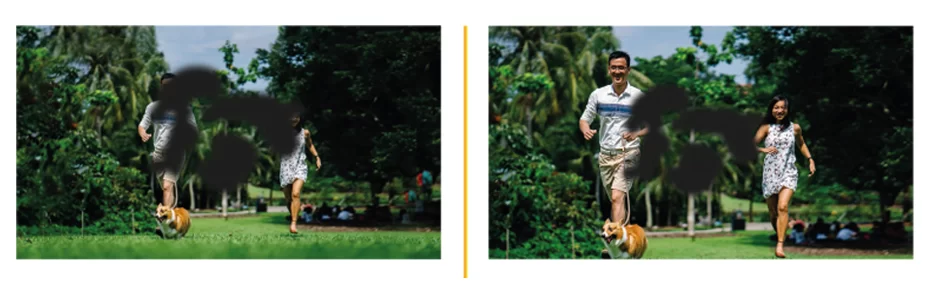
Macular Degeneration (AMD) and Macrovision

Age-related macular degeneration is the loss of central vision in the retinal layer of the eye as a result of the progression of cells in the macaque region (yellow spot) responsible for clear vision. The macular area is located behind our eyes and allows us to see the details.This performed by this region, we are able to read books, do work that requires many more finely detailed jobs.

In people with yellow spot disease, central vision loss begins in the center of the visual field with the death of nerve cells. This loss of vision, which begins in the center, expands towards the edges over time. Patients see a dark spot in the center and a ring on the edges.

What are the Types of Age-Related Macular Degeneration?

Age-related macular degeneration is also divided into two types in terms of development:

  • Dry Macular Degeneration: This is the most common type of yellow spot disease. This type is observed in 85% of yellow spot patients. In the macula area of the retina, small yellow substances called drusen accumulate and damage the macula, which can cause vision loss.
  • Wet Macular Degeneration: This type is seen in 10-15 percent of yellow spot patients. It occurs as a result of the dilation of blood vessels of abnormal structure under the macular. Macular structure is damaged due to bleeding and out of fluids. This can cause vision loss.

Apart from these two types, the young type of macular degeneration known as Stargardt’s disease is a type of yellow spot disease seen in children and young people.

What are the Risk Factors for Yellow Spot Disease (AMD)?

  • Women
  • Over 65 age people
  • People with colored eyes
  • Overweight people
  • Smoking
  • History of cardiovascular disease

What Causes Age-Related Macular Degeneration?

The retinal layer has its own vascular layer. This layer is also fed from another richer layer located under itself. Between these two layers there is a thin layer of membranes that act as filters. In the macular area, harmful substances formed by light and other factors are cleaned in this membrane layer. The cleaned harmful substances are transmitted to the rich layer at the bottom and excreted from this area with the help of the circulatory system.

Harmful substances that cannot be excreted for an unknown reason accumulate in this region, negatively affecting the visual system. Thus, yellow spot disease begins.

What are the Symptoms of Age-Related Macular Degeneration?

In age-related yellow spot disease, the cells in the macula are lost slowly. That is why the disease does not suddenly give very noticeable symptoms. Different symptoms may appear in different people.In some cases, only one eye symptom may appear and there are no problems in the other eye. In yellow spot disease, it is easier to diagnose only if both eyes are affected.

At the beginning symptoms are that the colors are dimmed, the texts are blurred and the straight lines begin to appear skewed. As yellow spot disease progresses, a dark area is formed in the center of the point at vision. As yellow spot disease progresses, a dark area is formed in the center of the point being looked at, problems with blurring and the skewed appearance of straight lines increase. In addition, more light is needed when doing close reading and finely detailed work.

There is difficulty in adapting to dimly lit environments. As the disease progresses, these problems make it impossible for individuals to carry out their daily activities alone after a while.

When Should You Go to a Doctor?

It is worth seeing the doctor the following cases:

  • You’ll notice a blacking out of your central vision.
  • You’ll have difficulty seeing colors and fine details, you’ll see straight lines oblique.
  • These changes can be the first signs of yellow spot disease, especially if you are over 60 years of age.
  • In addition, those with a family history of macular degeneration should be more sensitive about the symptoms of the disease.

How is the Treatment of Yellow Spot Disease?

Dry type treatment is mostly done with special vitamin supplements and high doses of Omega-3. All treatment is carried out with oral medications.

Wet type treatment is mostly done by injecting medicines called anti-VEGF into the eye. The aim here is not to cure the disease, but to prevent blindness. Multiple repetitions of these injections may be required.

Is There a Treatment for Yellow Spot Disease Other Than Medicine Using?

Vision can be improved with MACRO-vision operation and Macular Lens treatment.

MACRO-Vision Operation in Age-Related Macular Degeneration.

The retina’s central vision decreases due to diseases affecting the visual center. Therefore, patients with near vision and distant vision do not treat their existing diseases. However, this operation enlarges the image that falls into the retina, allowing them to see better distant and near despite macular diseases.

With MACRO-vision Surgery, Yellow Spot Disease Patients Will Be Able To See Better!

Age-Related Macular Degeneration (yellow spot disease) is the most important cause of decreased vision with advancing age. Unfortunately, when the disease progresses and atrophy occurs in the visual center, the vision of the patients decreases so much.

In the past, we used to follow these patients only and watch the disease progress gradually and then the vision decreased. Now, with Macrovision surgery, it may be possible to increase the eyes that have very low vision. With this surgery and the glasses used afterwards, the images that fall into the retina are enlarged. Therefore better vision even yellow spot disease.

The most important feature of Macrovision surgery is that it can be applied with cataract surgery in the appropriate eyes or it can be applied to the eyes that have already had cataract surgery. Patients who are eligible for this treatment can see better, provided that they wear glasses for far and near.

MACRO-Vision Surgery

Due to diseases affecting the visual center of the retina, it enlarges the image that falls into the retina without treating the existing diseases of patients. It is a surgical procedure that allows them to see better far and near despite macular diseases.The main purpose of the application of this procedure is to make the eye as a telescope system with applied lenses and glasses used after surgery. This procedure is a new silver lining for elderly patients with reduced vision due to yellow spot disease and difficulty in their daily work.

The most important feature of macro-vision surgery is that it can be applied to most patients with yellow spot disease and with very little vision. It can be applied with cataract surgery in patients with cataracts and yellow spot disease, as well as patients who have previously had cataract surgery.In other words, having surgery before is not an obstacle for this operation.

For years, in advanced dry type, or atrophic yellow spot disease, we were able to follow patients only through examinations. With Macrovision operation, it is possible to increase the vision of these patients without treating their diseases with using glasses after operation. In patients with young maculopathy, it is possible to apply this treatment with second lenses placed without touching the patients’ own lenses. During the examination, it is possible to perform a simulation examination of the application and estimate the amount of increase in patients’ (with macrovision) vision. Now, with macrovision surgery, yellow spot patients of all ages can see better with glasses both far away and near.

Contact
close slider